
Category: Cheeses
Cheeses So Bizarre, They Will Leave You Scratching Your Head
 Image Source: http://images.counselheal.com/data/images/full/5025/cheese.jpg
1. The Cheese Made of Real Gold- A Stilton Cheese
In hopes that this cheese will be a perfect addition to your Christmas menu, cheese makers created a stilton cheese… made of real gold. Clawson Stilton Gold is 67 times more expensive than regular stilton, selling for £60.87 per 100g slice, or £608 per kilo- almost 1,000 U.S. Dollars!
This cheese took the title of the most expensive cheese the UK has ever made. It would cost £6 just for the cheese to top one cracker! Clawson claims that the premium white Stilton is so high in price because it is shot-through with a mixture of real edible gold leaf and real gold liqueur. They also claim that they’ve even been contacted by a famous popstar and a Gulf- based oil Sheikh who are desperate to sample a piece of the expensive cheese.
2. The World’s Most Expensive Cheese- Pule
Pule, being Serbian for foal, is made at the Zasavica Special Nature Reserve in Belgrade, Serbia. It costs $1700 a pound! The reason being for this is donkey’s milk. It takes around 25 liters alone, of donkey’s milk to make a mere one kilogram of the white, crumbly cheese.
According to the dairy’s manager, there is no other special ingredient which goes into making the cheese, its price is just based purely on the going rate for donkey’s milk (around 45 dollars per liter). However, Pule isn’t produced commercially anyway, so even if you’re a billionaire, you wouldn’t be able to just rush over to your local cheese shop to buy some.
3. The Cheese That Is So Stinky, That It Was Banned From Public Transportation- Epoisses
Epiosses, one of the smelliest cheeses you can find, was one of Napoleon’s favorites. Just to give you a taste of how repulsive the odor of this cheese is, it was banned from public transportation all over France. This cheese is made from cow’s milk and is washed in pomace brandy.
It is a very smelly, runny cheese but they say if it starts to smell too strongly of ammonia, it is no longer edible and should be thrown away. However, if it smells like someone who hasn’t showered in a week, enjoy!
4. The Cheese Made With Flying Maggots- Casu Marzu
Popular on the Italian island of Sardinia, Casu Marzu is a sheep cheese. The name literally means “rotten cheese”, which is ironic, because it is made with maggots and also why some have adapted the name to “maggot cheese”.
To create the maggot cheese, you begin with a slab of local sheep cheese, Pecorino Sardo, but you let it go beyond natural fermentation to a stage of infested decomposition. Larvae of the cheese fly (Piophila
Casei) are then added to the cheese, and the acid from their digestive system breaks the cheese’s fats down, making the overall product liquidy and soft. Casu Marzu usually contains thousands of larvae by the time it is ready for consumption.
Generally, the locals consider it unsafe to eat the cheese once the larvae have died, so it is served with the translucent white worms, that are one-third of an inch long, still squiggling. Many people brush the maggots off the cheese before eating it, while some others do not. The people who leave the maggots on the cheese may have to cover it with their hands as the maggots can jump up to six inches when disturbed.
5. The Cheese Made With Mite Excrement
Germany is definitely the world’s cheese powerhouse, producing over 1.8 million tons of 400 odd varieties of cheese annually. However, among all that cheese, one cheese, in particular stands out the most. Made in Würchwitz, this cheese is a highly sought after delicacy because of its unusual production process.
By allowing quark to sit in thousands on dust mites, Milbenkäse is the cheese that is made. Enzymes come from the mites’ excrement and they ripen the cheese. After one month, the cheese turns into a yellowish color, after three months, it turns into a reddish-brown, and after a year, the cheese turns into a blackish lump, which is most desirable to aficionados. People consume the mites along with the cheese. It is often described to taste bitter; people also believe it may have curative effects that keep people from being allergic to house dust.
6. The Cheese That Doesn’t Melt- Halloumi
Originating from Cyprus, Halloumi is a traditional cheese. It is suitable for grilling and frying because of its high melting point. You won’t find any BBQ in Cyprus without Halloumi, as it is a delicacy.
Another odd, but a common thing you see is Halloumi eaten together with watermelon in the warm seasons. The juice from the watermelon is refreshing while the Halloumi gives of a delicious taste.
It is one of the dishes that you’ll usually see served in a Cyprus Meze, and quite often, you’ll see the cheese alongside a cold beer in a taverna.
7. The World’s Strongest Cheese- Vieux Lille
The alternate names of this cheese are “Puant de Lille” and “Puant Macéré”, and they quite literally mean “stinking pickle”. This is just a mere description of how pungent the smell of this cheese is.
A British cheesemonger, The Teddington Cheese, which sells cheeses from around the world, only calls few kinds of cheese “pungent”. This is because, when they describe something as pungent, they really mean it, their icon behind the word being a man in a gas mask. If they were asked which is the strongest cheese in their shop, Vieux Lille would be a ‘strong’ contender for first place. This cheese is NOT for the faint-hearted. Along with its pungent odor, it has a strong and salty flavor.
5 of the Best “Swiss” Cheeses You’ve Never Heard Of!
The 5 Best Swiss Cheeses You Need To Try!
 Image Source: http://www.bbc.com/travel/europe/switzerland
One of the most vital parts of the culture and history of Switzerland aside from its majestic landscapes and mountainous scenery, is its cheese. This is markedly evident as over 100 different cheeses are produced throughout Switzerland.
Cheese is a very important aspect of Swiss Culture! Dairy farming in the Swiss Alps dates back 2,000 years, to the time of ancient Romans, making it a crucial part of Swiss life and traditions. To this day, over 100 different cheeses are manufactured in Switzerland. It may come as a surprise that these cheeses are not mass-produced but in fact made in hundreds of smaller dairies which are controlled by a master cheese maker to ensure the best and most high standard cheeses.
Many cheeses of Switzerland often have their names plagiarized and abused. However, regardless of the fact that the cheeses are plagiarized, there is a long list of cheeses that originate from Switzerland.
Here is a list of the 5 best cheeses which are unique to Switzerland:
1. Appenzeller
This is a hard cheese made from cow’s milk. It is light-colored and cured in herbal brine using wine or cider. Its name is from the region is it manufactured in Appenzell, which is located in northeast Switzerland. The flavor is often said to be nutty or fruity, ranging from mild to tangy, with a strong smell to it.
2. Sbrinz
This cheese comes from central Switzerland and is unique because of 42 dairies in the region produce it. The cheese is extra hard with a smoother, nuttier flavor that has a less salty taste.
3. Schabziger/ Sapasago
This hard cheese is made in the Canton of Glarus region using skimmed milk and blue melilot (blue fenugreek), which is a herb which gives the cheese the green color. Its flavor is pungent, salty and sour which the smell matches.
4. Tilsit/ Tilsiter
This cheese is only semi-hard and dates back to the Prussian-Swiss settlers in the Mid- 19th Century. It is light-yellow colored with the flavor of a buttery, yet tangy kind that varies from slightly strong to pungent, depending on how long it has been aged. Sometimes it is said to taste like peppercorns.
5. Vacherin-Fribourgeois
This cheese is also semi hard and is manufactured in dairies of the canton of Fribourg. It is made from cow’s milk and has a semi to hard consistency and is covered in greyish- yellow rind. Because it is cured in damp conditions, it can be mildly acidic.
A World of Beer and Cheese!
Beer and Cheese: A New Marriage?
Beer and cheese may not be the first things you’d pair together, but believe it or not, the union of the two go all the way back to the Middle Ages. In fact, in Belgium, exceptional beer and cheeses were such an important part of their everyday lives, that even today it is a delicacy and small bowls of cheese are often served in beer bars to accompany your beer.
You may think the best suited alcoholic beverage to accompany cheese is wine. Although cheese can make the cheapest of wines enjoyable, wine can be overpowering to our taste buds at times and make it hard to relish delicious cheese to the fullest potential.
On the other hand, beer and cheese are both farmhouse products which automatically means they compliment each other. Typically, a farmer’s diet back in the day consisted of cold meat, cheese, and beer. Beer and cheese have very close origins, in the fact that barley, which is a cereal grass, is a product used to make beer and milk is a by- product of a cow eating grass. Consequently, the fact that they share such similar characteristics means that they are both alike in flavor and aroma and ultimately compliment each other greatly.
 Source: https://www.craftbeer.com/educational-resources/craft-beer-cheese-style-guide
How to pair beer and cheese
Try having your favorite beer with a plate of different cheeses and find one which you most enjoy with it, as the preference is the best way to find a pairing. Also, putting together complex beers with complex cheeses is a good tip when it comes to pairing the two.
Here’s a list of ideas when it comes to pairing beer with popular cheeses:
* Pale Ale with Sharp Cheddar
* Wheat Beer with Feta
* Fruit Beer with Mascarpone
* Pilsner with American Cheese
* Brown Ale with Colby
* Amber Lager with Parmesan
* Octoberfest Beer with Swiss Cheese
Basically, the main thing when it comes to pairing beer with cheese is having a play around with the process, experiment with your own preferences and remember that beer is the beverage which goes with all types of food or on its own, so theirs a huge variety of possibilities!
A Helpful Serving Tip:
Buy raw milk, cow, goat or sheep cheeses. Milk that is not pasteurized and has not been processed will culture while milk that has undergone pasteurization processes produces cheese whose scents and flavors are removed. Contrarily, cheese that are produced from raw milk are richer, fuller and support traditional cheese-making processes.
Beloved Cheeses From Around The World
The World Of Cheese
The glorious world of cheese began around 4,000 years ago. Although the oldest evidence of cheese comes from Switzerland, an Arab merchant in the Middle East claims to have made cheese by accident, on his journey through the desert. The merchant stored a supply of milk in a pouch made from a sheep’s stomach, which in turn, with help from the desert sun, curdled the milk, forming the mouth-watering flavor of cheese. Obviously, it was an instant hit in the world, and thus came The World Of Cheese!
 Source: https://pbs.twimg.com/profile_images/587949417577066499/3uCD4xxY.jpg
So which country loves cheese the most?
It may not ever dawn on you, but cheese consumption is actually dependent on genetics! It sounds bizarre that genetics can take any place in the consumption of glorious cheese, but when it comes to it- roughly 75 percent of the world’s population, 25 percent of that belonging to the U.S. alone, are lactose intolerant.
While only 5% of Caucasians are lactose intolerant, the table turns when it comes to those of east Asian descent and African descent, being that roughly 95% of east Asians and around 50% of people of African descent are lactose intolerant. This is why cheese is mainly found to have flourished in Europe as opposed to the regions of Asia and Africa. Through this knowledge, it is not surprising that the top 10 countries for cheese consumption per capita all fall within Europe, with France topping number 1 at 57.9 pounds per year and Netherlands being at number 10 with 42.7 pounds per year.
What are the most popular cheeses of the world?
A big part is played by climate when it comes to the world’s favorite cheeses. In places such as the Middle East and the Mediterranean, preservation of cheese was a challenge in the hot climate so salt was heavily added, to preserve. This is why Feta cheese is so loved in Greece. On the other end the climate spectrum, places such as the Alps, where caves served as great places to refrigerate cheese, fresher cheeses such as Gouda or Havarti could be relished.
Overall, the most favored cheese is dependent of climate as traditions date back 4,000 years ago, when modern day refrigeration was not an option. That being said, the indigenous adaptations follow through to this day, forming the different Nation favorites. The U.S. is a big combination of all Europe’s favorite cheese as it is a nation of immigrants, so it cannot really claim one indigenous favorite. (Native Americans had no dairy in their diet.) There are American cheeses today, but they’re mainly adaptions of European recipes. Latin America also holds a part in the United States’ favorite cheeses, with a lot of the nation being of Hispanic descent.
So, You Think You Know Cheese?
Cheese is one of the most hallowed and beloved foods on the planet, and is seemingly consumed on a daily or near-daily basis by a majority of the world’s populations. Cheese has been around since the beginning of time, it seems, and has transpired from a staple food to a culinary masterpiece.
 Source: http://www.ba-bamail.com/content.aspx?emailid=15982
Here are a list of cheese facts that may just add to the mystery, that is cheese and its curious cases…
Albeit, there is not much specific information concerning the history and origins of cheese, it is believed that cheese dates back to approximately 6,000 BCE, according to archaeologists. Experts have determined that, based on their findings, during that era, cheese was produced from the milk of cows and goats across Mesopotamia.
Studies have shown the mozzarella cheese has the highest rate of consumption of any other cheese on the planet. Moreover, there are over 2,000 different cheeses that are produced, circulated and consumed around the world.
Who are the largest consumers of cheese? Nope, not Italy or France, but Greece. On average, a person from Greece consumes about 60 lbs of cheese, annually, much of it coming in the form of Feta.
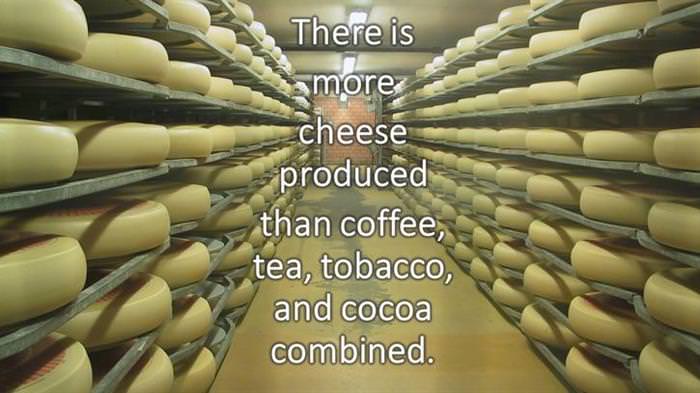
Cheese is the largest produced staple around the world. Its production is more than the production of coffee, tea, tobacco and cocoa beans, combined!
The very first cheese-making plan was born in Switzerland in 1815. The first mass production didn’t begin until 36 years later in the United States.
Cheese is an excellent source of protein, calcium and phosphorus, when eaten in moderation of course. Cheese gets a bad name mainly from its higher content of saturated fats.
Yes, the United States acknowledges the greatness of cheese. How so? They have dedicated the month of June to National Dairy Month while the last week of June is National Cheese Week.
Twenty million metric tons of cheese is produce on a global level annually and production will continue to increase every year.
On average, about 10 lbs of milk is needed to make just one pound of cheese. That’s a 10:1 ratio and seems like a ton of work for only one pound of cheese, but if it were not for cheese-making, a tremendous amount of milk would be wasted every year.
Cheese has a very long shelf life, and in some cases, cheese is exposed to mold which allows them to age properly. These cheeses include: Bleu Cheese, Gorgonzola and Brie, among others.
During the time of the Roman Empire, many larger homes belonging to Roman residents had separate kitchens that were designated for cheese-making. These kitchens were called “careale”.
Lastly, there are a number of cheeses that promote dental health as they prevent tooth decay. Cheese like mozzarella, cheddar, Swiss and American increases the amount of saliva flow which leads to elimination of sugar and acids from the mouth that would aid in decay.
Eating Cheese Can Lead To Weight Loss And A Healthier Lifestyle!
Ever wonder why Europeans have a lower heart rate and are more physically fit than their cross-ocean neighbors, Americans? Even though it seems as though European diets consist of intake that is seemingly through the roof in saturated fats, they still yield some of the most physically fit populations on the planet. Researches formerly attributed this to lifestyle practices and their penchant to indulge in wines. However, recent studies have shown that, you guessed it, cheese may also contribute a vital roll in the everyday healthy lifestyles of most Europeans. How can this be when many cheeses are high in fat content? Well, to counteract the high fat content, the healthy benefit stems from the potentially high metabolic rejuvenation within the cheese.
 Source: http://img-aws.ehowcdn.com/600x600p/photos.demandstudios.com/getty/article/142/87/86523919_XS.jpg
For the purpose of the study, scientists compared bodily fluid samples from a group of people whose diets consisted of higher intakes of milk or cheese as well as a controlled diet of butter but no other dairy was a part of their diet. Findings showed that those whose diet consisted of cheese had higher levels of butyrate in their bodily fluids as compared to other groups of people. Butyrate is a short chain of fatty acids that are produced by bacteria in your stomach. In a similar light, the increase in butyrate levels resulted in lower cholesterol. This makes the very valid argument that cheese could be a included in a diet geared toward to healthier lifestyle.
While science has not truly revealed exactly how butyrates contribute to a healthier lifestyle, other studies have shown butyrates improves insulin sensitivity, energy levels, all while reducing stress levels. A study conducted in 2009 that was presented in the journal of Diabetes, linked butyrates to a markedly reduced risk of obesity.
As much as some cheese has its health benefits, other cheese do not exemplify or promote as much of a healthy lifestyle as others. Aged cheeses will be your best shot at improving your healthy lifestyle and tackle the weight loss mission. Such cheese include aged cheddar, Parmesan and Greyere… among others. Butyrate can originate from two sources, mainly. I can be produced from cheese itself or from bacteria produced in the stomach after the consumption of certain foods. An expert in this study noted that in both instances, aged cheeses tend to result in an increased amount of butyrate than fresh cheeses.
As studies have shown, it’s something we should be aware of as it meshes well with earlier research showing that cheese can have the benefits of reducing cholesterol compared to other dairy products with similar fat content. With that in mind, consider adding aged cheese to your diet as it may prove to be a healthy move!
Now is the Time to Order Your Shisler’s Cheese House Holiday Gift Boxes
While Christmas is meant to be a joyous, happy and exciting time of the year, it can just as easily be a very hectic time of the year, especially if you really haven’t a clue what to get someone as a Christmas gift. Do you ever find yourself in a holiday version of a “writer’s block”? Never know what to get a friend, a family member or a colleague? Yes, these can be tough and stressful times, not sure what to get someone while racing against the clock, with time not on your side, as you try to make a dash for a last-minute gift at the department store or specialty store.
What if we told you, we have a solution for you? What if we, at Shisler’s Cheese House, can help alleviate your Christmas shopping worries and stresses by letting us create a magical Christmas experience for your loved ones, your friends and even your coworkers? Have we got your attention now? Shisler’s Cheese House offers a wide selection of Christmas gift boxes with assorted cheeses, meats and other goodies. With a number of different options and gift box assortments that you can choose from, you cannot go wrong.
GIFT BOX OPTIONS
Gift Box 1: Baby Swiss Cheese
Contents
– 4 lb. wheel of Baby Swiss

Gift Box 2: Troyer’s Trail Bologna & Cheese
Contents
– 1 Lb. Troyer’s Trail Bologna Ring
– 3/4 Lb. Wheel of Colby
– 3/4 Lb. Wheel of Farmers
– Assorted Chocolates

Gift Box 3: Cheese Lover’s
Contents
– 3/4 Lb. Wheel of Cheddar
– 3/4 Lb. Wheel of Cojack (Marble)
– 3/4 Lb. Wheel of Farmer’s Cheese
– 3/4 Lb. Wheel of Pepper Jack
– Assorted Chocolates

Gift Box 4: Amish Cheese & Goodies
Contents
– 1 Lb. Baby Swiss Wheel
– 1 Summer Sausage Link
– 3/4 Lb. Wheel of Colby
– 3/4 Lb. Wheel of Pepper Jack
– Shisler’s Private Label Mustard
– Home Style Amish Jam
– Carr’s Crackers
– Assorted Chocolates
– 6 oz. REACH Coffee

Gift Box 5: Baby Swiss Cheese & Troyer’s Trail Bologna: A Classic Amish Country Combination
Contents
– 4 Lb. Baby Swiss Wheel
– Large Troyer’s Trail Bologna Ring
– Shisler’s Private Label Mustard
– Carr’s Crackers
– Assorted Chocolates
– 6 oz. REACH Coffee

Gift Box 6: Amish Country Sampler Gift Box
Contents
*The best that Amish Country has to offer! Our Amish Country Sampler Gift Box includes*
– Large Troyer’s Trail Bologna Ring
– 1 Lb. Box of Heggy’s Chocolates
– Home Style Amish Jam
– Shisler’s Private Label Hot Jalapeno Mustard
– 3/4 Lb. Wheel of Cheddar
– 3/4 Lb. Wheel of Cojack (Marble)
– 3/4 Lb. Wheel of Farmer’s Cheese
– 3/4 Lb. Wheel of Pepper Jack Cheese
– Baby Swiss Cheese Wedge
– Summer Sausage Link
– Townhouse Crackers
– 6 oz. REACH Coffee

Best Cheeses To Eat As The Weather Turns Colder
 Source: http://www.dairyinstitute.org/wp-content/uploads/2015/02/cheese2.jpg
Cheese is great anytime of the year, but as with many foods out there, cheeses can be different in taste, texture, and quality with the changing of the seasons. For example, a number of cheeses will exhibit their peak flavor and texture during the cooler/colder months of the year. These types of cheese are classified into two groups, that is (1) cheeses made from the milk of animals that is produced during peak spring and summer months, usually falling between May and October and (2) cheeses made from the milk of animals produced during peak fall and winter months, usually falling between November and March).
Not only do cheeses themselves vary fundamentally from season to season, but they can also exhibit distinct seasonal variability from region to region. This revolves around when the temperatures turn too cold for animals to remain outside. During peak spring and summer months, animals producing dairy products consume fresh grass, wild flowers, herbs and any other plants, shrubs or grasses that nature may sprout up. On the contrary, as the weather turns colder, these animals remain in sheltered environments and their diets consist mainly of dried hay or silage (grasses which are harvested and gathered at their peak state and preserved for the winter by fermentation processes). With this change in seasonal diets, particularly during the winter months, the animal still produces milk, albeit, the volume and flavors are not at their peak as they would be in spring and summer dairy production; during the spring and summer months, the milk has a distinct sweet, herbal flavor from the grasses and wild flowers the animals consume from the mountain side.
While a number of cheeses are best when aged, this is not the case for all cheeses. Non-aged cheeses are at their peak during the spring and summer months. This would include cheeses such as mozzarella, feta and chevre. Cheeses which are aged, however, can take a longer time to reach their peak flavor and texture. This means that cheeses made from animals’ milk during the spring and summer months may have to wait until the following year to be able to enjoy the full value of the cheese.
Cheeses made from animals’ milk in the spring and summer months which are at their peak flavor and texture by the following winter are:
- Appenzeller
- Comte
- Gruyere
- Colston Basset Stilton
- Cabrales
- Morbier
- Raclette
- Rogue River Blue
- Uplands Cheese Pleasant Ridge Reserve
With the colder months of winter, come cheeses that are produced from the milk of animals whose diet consists mainly of dried hay. These cheeses will be void of many of the distinct, vibrant flavors of cheeses produced from milk produced in spring and summer. However, cheese produced from milk during winter months have a higher fat content which yields very rich cheeses. One of the most highly touted cheeses on the planet comes from winter milk from the same breed of cows that produce summer milk that makes Gruyere called, Vacherin Mont d’Or.
Because of the overall decrease in the overall production of milk during the winter months, winter milk cheeses are generally on the smaller end of the size spectrum while the aging process is over a much shorter time period.
Shisler’s Fine Line of Products can help you bring in Fall and Winter
As we delve further into the heart of Fall, with Winter to follow, moods get dull and that spice of life seems to dissipate over the course of time through the year’s last few months and the through the handful of months to start a new year. This is what we sometimes call the Fall and Winter Blues. But, it does not have to be this way. We can always enjoy the finer things Fall and Winter has to offer. For example, waking up on a Fall morning to a nice cup of coffee or tea, throwing on a hoodie and hiking the open trails painted with Fall colors, or, waking up on a winter morning with nowhere to go and wrapping that extra blanket around you for just another hour of sleep. While Fall and Winter can bring out the blues in many a number, I prefer to think the spice of life can still be found over these two seasons, if we just try to look hard enough.
Speaking of the spice of life, Shisler’s can help you bring out the best of Fall and Winter with our line of products that can add that extra zest to any blues-infested mood.
Who doesn’t love a good piece of cheese, complimented with a glass of fine wine. To see our line of fine, aged (or not aged) imported and domestic cheeses, please visit HERE.
 Source: https://douglasgreen.files.wordpress.com/2011/10/wine-and-cheese.jpg
Chocolates are amazing anytime of the year. However, they become increasingly desirable and irresistible as the seasons change, especially as colder weather becomes the trend. Shisler’s is well-known for the chocolates we carry, and we are proud to carry signature chocolates from Heggy’s and Stefanelli’s. Our selection of Heggy’s Chocolates is a vast one featuring everything from assorted milk chocolates to maple walnut creams. With such a vast selection to choose from, there is an option for almost everyone. Our selection of Stefanelli’s includes their signature “Sponge Candy” which a combination of sea-foam toffee covered in chocolate. From experience, let me tell you this… once you have one, it is essentially game over as you’ve fallen victim to the domino effect. Once you have one, that turns to two, two turns to three… and so on. Trust me when I tell you this, the effect is real. To see our selection of chocolates, please visit HERE.
 Source: http://www.laurascandy.com/images/chocolate.jpg
Finally, if all this were not enough to cure the Fall and Winter blues, let our selection of gourmet foods help rejuvenate, not only your mood, but your taste buds. Wake up on a cold Winter morning to a buttered roll, and instead of using “Land O’ Lakes” butter, try some of our locally, homemade Rolled Amish Butter. If you’re in an undeniable mood for pancakes or waffles, choose from our selection of locally, homemade maple syrups and try them in our wide selection of flavors including: Blackberry Pecan, Blueberry, Cinnamon Sticky Bun, Lavender, Red Raspberry and Shagbark Hickory. With such a selection of incredible flavors, you really cannot go wrong. And, if you are up for a delicious, hot cup of tea, we some fantastic honey that will compliment any cup of tea. To see our selection of specialty foods, please visit HERE.

Photo Credit: Stephen Hamilton
The Best Ways to Eat Cheese: Part 2
This will continue part two of our “The Best Ways to Eat Cheese” miniseries. Who doesn’t like cheese? Who doesn’t like a good miniseries? If you didn’t raise your hand for either of these critical questions, you’re again, in the right place. In the first part of this miniseries, we discussed some of the tantalizing ways that we can infuse cheese in a number of dishes, and even desserts. From cheese-stuffed meatballs to cheese-infused pie crust to a ham and cheese bread bowl, there was something from just about everyone’s taste buds. And, the best part, there were all relatively easy to make and didn’t really break the bank, which is always a great thing!
In part two of this miniseries, we will divulge a number of other foods that we can secretly infuse with cheese that will create a pronounced flavor to an already delicious culinary masterpiece.

Stuffed Peppers… with Cheese!
We’ve all had or even made stuffed peppers at some point in our lives, and if you haven’t, what on Earth are you waiting for? For as delicious as stuffed peppers can be if made with that added touch of TLC, a remarkable version of this dish can created by infusing the meat with your favorite cheese!
Apples and Oats… don’t forget about the Cheese!
When making apples and oats, alone, it is a pretty awesome and dynamic flavor of tart and sweet. Adding cheese to this will create a far more dynamic concoction that will leave your taste buds begging for more. This treat becomes a masterpiece when using Brie as your cheese of choice, infused within the apple and oats, and you actually get that cheese pulling effect every time when using Brie!
Cheese Soup
One of the simplest recipes on Earth is making soup. This recipe can be complex depending on what kind of soup you’re making. Easily heighten the flavor of the soup by either adding cheese to it or making the broth of the soup cheese-based. Here is a great recipe for Beer and Cheese soup
Ingredients
- 2 cups (450g) wheat beer or pale ale
- 3 tbs (30g) cornstarch
- 16 ounces (450g) sharp white cheddar, grated
- 1 cup (240g) broth (vegetable or chicken)
- ½ cup (120g) heavy cream
- 1 tsp (4g) red pepper sauce
- salt and pepper to taste
- ¼ cup chopped chives
- 2 cup (200g) tater tots, cooked according to package directions*
Instructions
- Add the beer, cornstarch, cheddar, broth, heavy cream, and red pepper sauce to a blender. Blend on high until very well combined, about 5 minutes.
- Add to a pot over medium high heat, simmer until warmed and slightly thickened.
- Season with salt and pepper to taste, stir in chives.
- Ladle into serving bowls, top with tater tots, serve immediately.
Source: http://thebeeroness.com/2015/09/23/10-minute-tater-tot-beer-cheese-and-chives-soup/
Cheese with Salad… That Simple!
Take you favorite salad, and add cheese to it. It can be any kind of salad… vegetable salad, green salad, fruit salad, antipasto salad. Just add some of your favorite cheese as a topping or add the cheese another “main ingredient” to the salad. Here is a unique recipe for making Watermelon, Radish, Orange and Goat Cheese Salad
- 1 shallot or half of a small red onion
- 2 to 3 tablespoons white balsamic vinegar
- kosher salt
- 2 to 3 watermelon radishes
- 2 to 3 oranges, clementines, grapefruit, etc.
- a handful of walnuts, toasted and chopped (see notes)
- goat cheese to taste
- chives, minced, optional, but they add some nice color
- olive oil to taste
- Mince shallot. Place in small bowl. Cover with 2 to 3 tablespoons of the vinegar depending on how big of a salad you are making. Add a pinch of salt. Set aside.
- Cut off one end of the radish. Leave the other intact so you have a handle when you run the radish down your mandoline. Peel the radishes if you wish, though it is by no means necessary. Thinly slice on a mandoline. (Note: I ate one slice unpeeled and thought it tasted fine but went ahead and peeled them anyway because I thought the salad might look prettier if they were peeled, but I don’t think it actually really matters.) Arrange radish slices on a platter. I try to fold some of them so they’re not all squished down in one flat layer, but arrange however you wish. Season all over with salt.
- Cut off each end of each orange. Squeeze each end over the radishes, then discard. Use a sharp knife to remove the skin from the orange. Cut in between membranes to remove each slice. Squeeze remaining membrane all over the radishes to extract any juice. Scatter oranges over the radishes.
- Scatter walnuts and goat cheese to taste over the radishes and oranges. Pour macerated shallots and vinegar over top. Drizzle olive oil to taste (one to two tablespoons) over top. Scatter chives over top if using.
- Let sit a few minutes (or longer — it benefits from a brief rest) before serving.
Source: http://www.alexandracooks.com/2014/12/24/watermelon-radish-orange-goat-cheese-salad/
Simply Fry It!
Cheese, in and of itself, is a delicious staple of food. It can come in various sizes, shapes, colors, textures, tastes, ages, among many other variations. Cheese takes on an entirely new level of taste when you decide to fry it. While it may not be the healthiest sound option, it sure is delicious. Sometimes its good to be a little bad, ha! Here is a recipe for Fried Goat Cheese with Honey. That sounds delicious just thinking about it!
- 4 oz goat cheese, cut into eights
- 1 egg
- ½ cup rice flour
- ½ cup club soda
- 1½ cup panko
- Honey, for drizzling
Instructions
- Heat oil in a cast iron pan to 1″ depth over medium heat to a temperature of 375.
- Take each piece of goat cheese and roll in a ball.
- In a shallow bowl, whisk together the rice flour, egg and club soda. Place the panko in another bowl.
- Roll each ball in the egg mixture, then coat with the panko. Repeat the process and then place the coated ball on a piece of wax paper. Repeat with the remaining seven balls. Place in freezer for 10 minutes until firm.
- Drop each ball in the oil, turning until they are golden brown, about 3-4 minutes. Remove to a paper towel to drain, then place on serving plate and drizzle with honey
- Serve immediately.
Source: http://www.gogogogourmet.com/fried-goat-cheese-balls-with-drizzled-honey/

