
Search Results for: swiss cheese
Amish Country Swiss Cheese Pie

Here is a wonderful recipe with Amish Country Swiss Cheese as the principle element While there are many cheeses on the market that fall under the broad title of “Swiss Cheese”, including almost anything with holes at your local grocery store, we have found that the proper cheese will make or break the recipe. The mass-produced cheeses found at most grocery stores typically use chemicals to speed the aging process. But those chemicals of leave a metallic aftertaste to the cheese, which can negatively alter the taste of the pie. For anyone desiring a bolder flavor, trying substituting the Swiss cheese with Emmentaler or adding some sharp swiss into the mixture.
Ingredients
For the Crust:
- 1 ½ cups sifted cake flour
- 1 ½ teaspoon salt
With fingertips, work it until crumbly:
- 1/4 lb. butter or margarine (½ cup)
Slowly add, stirring with fork:
- 1/4 cup cold water
For the filling:
Fry until crisp:
- 12 slices of smoked bacon
- 1/4 lb. of grated Swiss cheese
Into bowl break:
- 4 eggs
then add:
- 2 cups of cream
- 3/4 teaspoon of salt
- Pinch of nutmeg
- Heavy pinch of sugar
- Pepper to taste
Preparation
Crust:
Shape the mixture into a ball and roll it in wax paper; chill it in the refrigerator, about 1/2 hour or until it’s easy to roll. Preheat the oven to 425°F. On a floured board, roll the dough into a large circle about 14 inches in diameter and fit it into 11” pie plate. Make a fluted edge as shown. Aerate the crust well with a fork. Place it in the refrigerator for about 30 minutes.
Filling:
Beat the mixture thoroughly with an egg beater. Take the piecrust from the refrigerator and rub the inside with 1 tablespoon of butter. Sprinkle the bacon bits, and then the grated cheese evenly in the bottom of the piecrust. Pour the cream mixture evenly over all.
Bake for 15 min., then reduce the oven temperature to 300°F, bake for 40 minutes longer or until a knife inserted into the center comes out clean.
Serve hot, cut into pie wedges.
Swiss Cheese or “Swiss” Cheese?

Ohio Swiss Cheese
We all know what Swiss cheese is. An image probably comes to mind of the neatly pre-sliced cheese we buy in small packs from the grocery store characterized by its myriad of holes. It has a mild taste and the slices are good for making sandwiches. But do we know where it came from? Most non-cheese connoisseurs do not.
The concoction riddled with holes that we know as Swiss cheese was inspired by specific types of cheese that originated in…you guessed it…Switzerland. However, the cheese you buy in the grocery store is very different from the real, premium Swiss cheese, which is still available today, and doesn’t cost an arm and a leg unless you are a purist and insist that the only real Swiss cheese is imported from Switzerland.
The “Swiss” cheese that was the original inspiration for what we now call Swiss cheese is called Emmental or Emmentaler. Emmentaler is so named because the particular process by which the cheese is made originated in the Emme Valley, in the Canton of Bern, Switzerland. The process involves certain natural bacteria consuming the lactic acid in the cheese and releasing carbon dioxide gas, which slowly forms the bubbles that create the perfectly round holes that characterize Swiss cheese. Cheese experts often refer to these holes as “eyes.”
This process that was born in the Emme Valley has inspired a large number of the cheeses we enjoy today. Emmentaler is now produced in other European countries like France, Finland and Germany as well as it’s native Switzerland. Jarlsberg from Norway, and Leerdammer and Maasdam from The Netherlands are all similar variations of the original “Swiss Cheese.” But the problem we have in North America is that importing food can be an expensive process, from transporting it under the proper conditions to the government inspection standards. That all adds to the price of the cheese we enjoy, making it a luxury product. But those on a budget can still enjoy delectable Swiss cheese.
The problem with the mass produced Swiss cheese we find in the grocery store is that the production process has lost its integrity in the name of high volume output. This is often debated, but generally the larger the eyes, the more pronounced the flavor of the cheese. The reason for this is that the conditions that provide the ideal flavor, longer aging at higher temperatures, are also the ideal conditions for the enzymes and bacteria to create larger eyes. This creates two problems with mass producers that are focused on turning a profit. The longer aging process slows production, and the larger eyes make it difficult to neatly slice the cheese on mechanical slicers, because the cheese comes apart. Both of these factors cost time and money, so Swiss cheese manufactured in North America is often less aged and flavorful than imported varieties.
So how can we enjoy good Swiss cheese without spending an arm and a leg? We buy it from a “cheese artist”, rather than a “cheese business.” During the wave of European immigration to North America in the late 19th and early 20th centuries, many immigrants from the canton of Bern, Switzerland, where the original Emmentaler was produced, settled in Northeastern Ohio in what is now Holmes County. Holmes County, OH is now also the largest Amish settlement in the world. The Swiss immigrants brought their cheese making traditions with them, and although production has been aided by some automation, the original process is still strictly adhered to. But the process is not the only element necessary to successfully produce incredible Swiss cheese. It is essential that the milk used in making the cheese comes from specific types of cows that graze in specific grasses. All of those elements are present in Holmes County Ohio, and the milk is provided by local Amish farmers who do not give their cows hormones or antibiotics or add preservatives to the milk. The result is a Swiss cheese that tastes as good, if not better than the original Emmentaler that is imported from Switzerland, at approximately 1/3 the price.
Shisler’s Cheese House, a specialty cheese retailer located in Northeastern Ohio, conducted a double-blind taste test pitting imported Swiss Emmentaler against locally produced Pearl Valley Swiss Cheese, a fourth generation owned and operated cheese maker from Holmes County, OH. Of all the customers surveyed, approximately 10% were undecided, 10% said they preferred the imported Emmentaler, 20% said they liked both equally, and 60% preferred the locally made Ohio Swiss cheese.
So if you are a chef who likes to include fine cheeses in your recipes, you entertain frequently, or are simply a cheese enthusiast with a taste for fine Swiss cheese, you don’t have to take out a second mortgage to buy imported cheese or sacrifice quality for affordability. All you have to do stop into one of the local cheese stores in Northeastern Ohio, or if that’s not an option you can order online from www.cheeshouse.com/ohio-swiss-cheese. They ship to all 50 states and Canada.

Smoked Swiss Cheese
Here is a smoked version of our Ohio Amish Swiss Cheese
Description of Ohio Swiss Cheese
Our Amish swiss cheese is made locally in Pearl Valley, Ohio. The time honored process for making swiss cheese was brough here from Switzerland by the local population of Amish and Mennonite people. At Shisler’s we have selected what we believe to be the best locally made swiss cheese. Our Swiss cheese can also make an excellent low cost substitute for Gruyere cheese.
History of Swiss Cheese
Our locally made Amish swiss cheese closely resembles the original Swiss Emmental Cheese, which was originally produced in the Swiss canton of Bern . Local Swiss cheese has a distinctive appearance, as the blocks of the cheese are riddled with holes known as “eyes”. Swiss cheese is known for its nutty, bittersweet taste.
What Causes Holes in Swiss Cheese?
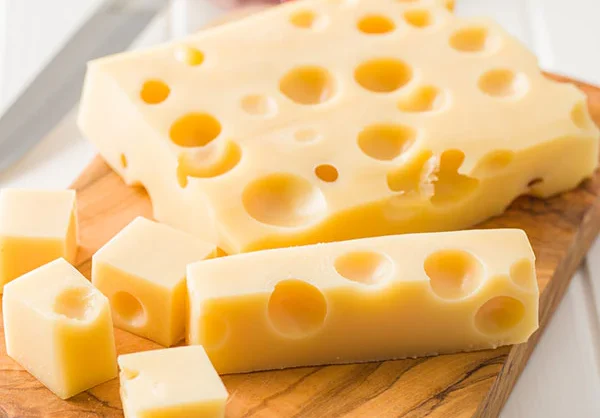
The process of making Swiss Cheese involves certain natural bacteria consuming the lactic acid in the cheese and releasing carbon dioxide gas, which slowly forms the bubbles that create the perfectly round holes that characterize Swiss cheese. Cheese experts often refer to these holes as “eyes.”
Why Ohio Swiss Cheese is Better
This is often debated, but generally the larger the eyes, the more pronounced the flavor of the cheese. The reason for this is that the conditions that provide the ideal flavor, longer aging at higher temperatures, are also the ideal conditions for the enzymes and bacteria to create larger eyes. This poses a problem for makers of pre-sliced Swiss cheese. Cheese with large eyes doesn’t slice well, sometimes coming apart in mechanical slicers. This costs time and money and is one reason why US manufacturers usually produce a product less aged and flavorful than the Amish swiss cheese made in Northeastern Ohio. It is also essential that the milk used in making the cheese comes from specific types of cows that graze in specific grasses. All of those elements are present in Holmes County Ohio, and the milk is provided by local Amish farmers who do not give their cows hormones or antibiotics or add preservatives to the milk. The result is a Swiss cheese that tastes as good, if not better than the original Emmentaler that is imported from Switzerland, at approximately 1/3 the price.
Baby Swiss is another related cheese. Made by substituting water for the milk’s whey to slow bacterial action, Baby Swiss cheese has smaller holes and a milder flavor. Baby Swiss is made from whole milk. Lacy Swiss is a further variety of US small hole Swiss cheese made with low fat milk.
Wine Pairing for Ohio Swiss Cheese
Ohio Swiss cheese pairs very well with numerous wines, but the most popular pairings are Cabernet Sauvignon and Merlot. Beaujolais and Pinot Noir are also great matches. If you prefer white wine, Chardonnay, Riesling, and Sauvignon Blanc pair well with Ohio Swiss cheese. And for the beer lover, Ohio Swiss cheese goes well with Lager, Pale Ale, and Weiss Beer.

Gift Box #5 – Baby Swiss Cheese and Troyer’s Trail Bologna: A Classic Amish Country Combination
- 2 Lb. Baby Swiss Wheel
- Troyer’s Trail Bologna Ring
- 3/4 Lb. Colby
- Shisler’s Private Label Mustard
- Carr’s Crackers
- Assorted Chocolates

Ohio Swiss Cheese
Ohio Swiss Cheese or more specifically our Amish sliced swiss cheese is made locally in Pearl Valley, Ohio. The time-honored process of making swiss cheese was brought here from Switzerland by the local population of Amish and Mennonite people. At Shisler’s, we have selected what we believe to be the best locally-made swiss cheese. Our Swiss cheese can also make an excellent low-cost substitute for Gruyere cheese.
History of Swiss Cheese
Our locally made Amish swiss cheese closely resembles the original Swiss Emmental Cheese, which was originally produced in the Swiss canton of Bern. Local Swiss cheese always has a distinctive appearance, as the blocks of the cheese are riddled with holes known as “eyes”. Swiss cheese is known for its nutty, bittersweet taste. This unique look and delicious taste have made Swiss Cheese become one of the most iconic cheeses around!
What Causes the Holes in Swiss Cheese?
The process of making Swiss Cheese involves certain natural bacteria consuming the lactic acid in the cheese and releasing carbon dioxide gas, which slowly forms the bubbles that create the perfectly round holes that characterize Swiss cheese. Cheese experts often refer to these holes as “eyes.”
Why Ohio Swiss Cheese is Better
This is often debated, but generally the larger the eyes, the more pronounced the flavor of the cheese. The reason for this is the conditions that provide the ideal flavor. Longer aging at higher temperatures is the ideal condition for the enzymes and bacteria to create larger eyes. This poses a problem for makers of pre-sliced Swiss cheese. Cheese with large eyes doesn’t slice well, sometimes coming apart in mechanical slicers. This costs time and money and is one reason why US manufacturers usually produce a product less aged and flavorful than the Amish swiss cheese made in Northeastern Ohio. It is also essential that the milk used in making the cheese comes from specific types of cows that graze in specific grasses. All of those elements are present in Holmes County Ohio, and the milk is provided by local Amish farmers who do not give their cows hormones or antibiotics or add preservatives to the milk. The result is a Swiss cheese that tastes as good, if not better than the original Emmentaler that is imported from Switzerland, at approximately 1/3 the price.
Baby Swiss is another related cheese. Made by substituting water for the milk’s whey to slow bacterial action, Baby Swiss cheese has smaller holes and a milder flavor. Baby Swiss is made from whole milk. Lacy Swiss is a further variety of US small-hole Swiss cheese made with low-fat milk.
Wine Pairing for this Cheese
Ohio sliced Swiss cheese pairs very well with numerous wines, but the most popular pairings are Cabernet Sauvignon and Merlot. Beaujolais and Pinot Noir are also great matches. If you prefer white wine, Chardonnay, Riesling, and Sauvignon Blanc pair well with Ohio Swiss cheese. And for the beer lover, Ohio Swiss cheese goes well with Lager, Pale Ale, and Weiss Beer.
If you prefer imports, try our Gruyere Cheese.

Gift Box #1: Baby Swiss Cheese
Baby Swiss Cheese
This is a fantastic gift box containing a 4lb wheel of Baby Swiss cheese as well as an assortment of chocolates.
Having the whole family around during the holiday season? Grab this gift box that contains a whole 4Lb. Baby Swiss Cheese Wheel. Our Baby Swiss is made in Charm Ohio, by the original producer Guggisberg Cheese. It is a young, semi-soft whole milk cheese with small holes and a mild flavor. It also comes with chocolates for those with a sweet tooth!
Baby Swiss is another of our local selections, made in Charm, Ohio by the original producer Guggisberg Cheese. Some of Our other Signature local cheeses include Swiss, Sharp Swiss, Amish Butter Cheese, Yogurt Cheese, and several variations of each. Baby Swiss is a young, semi-soft whole milk cheese distinguishable by its myriad of small holes. Baby Swiss is closely related to Swiss cheese, made by substituting water for the milk’s whey to slow bacterial action, Baby Swiss has smaller holes and a milder flavor. Baby Swiss is often made from whole milk. Baby Swiss has a delightfully creamy and mild taste, a delicious favorite!
History of Baby Swiss
Baby Swiss originated in 1967 just outside of Charm, Ohio, and was invented by cheese connoisseur Alfred Guggisberg, an alumnus of the famous Swiss Federal “Molkereishulle” (cheese maker’s institute). The name Baby Swiss was coined by Alfred’s wife, Margaret Guggisberg, who thought that in comparison to the larger wheels of traditional Swiss cheese, when placed side by side, the new cheese looked like a baby.
We love this gift box as it feels truly special to receive a whole wheel of cheese and we know whoever you are gifting it to will absolutely love it!
- 4 Lb. Baby Swiss Wheel
- Assorted Chocolates

Baby Swiss Cheese
Baby Swiss is another of our local selections, made in Charm, Ohio by the original producer Guggisberg Cheese. Some of our other signature local cheeses include Swiss, Sharp Swiss, Amish Butter Cheese, Yogurt Cheese, and several variations of each.
Baby Swiss is a young, semi-soft whole milk cheese distinguishable by its myriad of small holes. Baby Swiss is closely related to Swiss cheese, made by substituting water for the milk’s whey to slow bacterial action, Baby Swiss has smaller holes and a milder flavor. Baby Swiss is often made from whole milk. Baby Swiss has a delightfully creamy and mild taste, a delicious favorite!
Smoked Baby Swiss is also available, along with Lacy Baby Swiss for those who prefer a lower calorie version.
History of Baby Swiss
Baby Swiss cheese originated in 1967 just outside of Charm, Ohio, and was invented by cheese connoisseur Alfred Guggisberg, an alumnus of the famous Swiss Federal “Molkereishulle” (cheese maker’s institute). The name Baby Swiss was coined by Alfred’s wife, Margaret Guggisberg, who thought that in comparison to the larger wheels of traditional Swiss cheese when placed side by side, the new cheese looked like a baby.

Like its close relative Swiss cheese, Baby Swiss pairs very well with numerous wines. The most popular pairings are Cabernet Sauvignon and Merlot. Beaujolais and Pinot Noir are also great matches. If you prefer white wine, Chardonnay, Riesling, and Sauvignon Blanc pair well with Baby Swiss. And for the beer lover, Baby Swiss goes well with Lager, Pale Ale, and Weiss Beer.
*Also pictured is Shisler’s Private Label Hot Jalapeno Mustard
Baby Swiss is also included in several of our signature Gift Baskets
Pearl Valley Cheese Ohio: Tradition, Taste, and Swiss Excellence
Pearl Valley Cheese Ohio: Tradition, Taste, and Swiss Excellence
Nestled in the rolling hills of Amish Country, Pearl Valley Cheese Ohio has been a local treasure since 1928. Known for producing world-class Swiss cheese and a variety of award-winning dairy products, Pearl Valley is a shining example of what happens when generations of skill meet a passion for tradition.
A Family-Owned Legacy Since 1928
Pearl Valley Cheese was founded by Swiss immigrant Ernest Stalder and has remained a family-owned business ever since. Located in Fresno, Ohio, just outside Holmes County, the heart of Amish Country, the company still follows many of the same methods and recipes that Ernest used nearly a century ago.
Today, the fourth generation of the Stalder family continues to oversee the business, maintaining a firm commitment to quality, consistency, and community values. This dedication has helped Pearl Valley become one of the most respected names in Ohio cheese making.
Image Courtesy of Pearl Valley Cheese
Award-Winning Swiss Cheese
The signature product at Pearl Valley Cheese Ohio is their classic Swiss cheese—famous for its creamy texture, mild nutty flavor, and iconic holes. Made with milk from local, pasture-raised cows, their Swiss cheese has won multiple national and state awards, including honors from the World Championship Cheese Contest and the Ohio State Fair.
In addition to Swiss, the company offers a wide range of cheeses including:
Each variety is made with care, using time-tested techniques that result in authentic, flavorful products.
What Makes Pearl Valley Cheese Ohio Special?
One reason Pearl Valley Cheese stands out is their commitment to using only the freshest local milk, delivered daily from small, family-run farms. This not only supports the local agricultural economy but ensures top-tier quality in every batch of cheese.
Visitors to the Pearl Valley Cheese factory can watch the cheese-making process through large viewing windows and sample their fresh cheeses at the on-site retail store. It’s a must-visit stop on any tour of Ohio’s Amish Country.
Where to Find Pearl Valley Cheese
You can purchase Pearl Valley Cheese products directly at their factory store in Fresno or order online through specialty retailers like Cheesehouse.com’s Pearl Valley Collection, which offers a curated selection of their most popular cheeses for nationwide shipping.
Looking for a gift? Check out the Cheese Gift Boxes section for perfect holiday or corporate gifting options that showcase the best of Amish Country cheese.
Final Thoughts
Pearl Valley Cheese Ohio is more than just a cheese company—it’s a testament to tradition, family heritage, and the art of quality cheese making. Whether you’re a local resident or visiting Holmes County for the first time, a bite of Pearl Valley’s award-winning Swiss cheese is a taste of Ohio’s finest.
5 of the Best “Swiss” Cheeses You’ve Never Heard Of!
The 5 Best Swiss Cheeses You Need To Try!
 Image Source: http://www.bbc.com/travel/europe/switzerland
One of the most vital parts of the culture and history of Switzerland aside from its majestic landscapes and mountainous scenery, is its cheese. This is markedly evident as over 100 different cheeses are produced throughout Switzerland.
Cheese is a very important aspect of Swiss Culture! Dairy farming in the Swiss Alps dates back 2,000 years, to the time of ancient Romans, making it a crucial part of Swiss life and traditions. To this day, over 100 different cheeses are manufactured in Switzerland. It may come as a surprise that these cheeses are not mass-produced but in fact made in hundreds of smaller dairies which are controlled by a master cheese maker to ensure the best and most high standard cheeses.
Many cheeses of Switzerland often have their names plagiarized and abused. However, regardless of the fact that the cheeses are plagiarized, there is a long list of cheeses that originate from Switzerland.
Here is a list of the 5 best cheeses which are unique to Switzerland:
1. Appenzeller
This is a hard cheese made from cow’s milk. It is light-colored and cured in herbal brine using wine or cider. Its name is from the region is it manufactured in Appenzell, which is located in northeast Switzerland. The flavor is often said to be nutty or fruity, ranging from mild to tangy, with a strong smell to it.
2. Sbrinz
This cheese comes from central Switzerland and is unique because of 42 dairies in the region produce it. The cheese is extra hard with a smoother, nuttier flavor that has a less salty taste.
3. Schabziger/ Sapasago
This hard cheese is made in the Canton of Glarus region using skimmed milk and blue melilot (blue fenugreek), which is a herb which gives the cheese the green color. Its flavor is pungent, salty and sour which the smell matches.
4. Tilsit/ Tilsiter
This cheese is only semi-hard and dates back to the Prussian-Swiss settlers in the Mid- 19th Century. It is light-yellow colored with the flavor of a buttery, yet tangy kind that varies from slightly strong to pungent, depending on how long it has been aged. Sometimes it is said to taste like peppercorns.
5. Vacherin-Fribourgeois
This cheese is also semi hard and is manufactured in dairies of the canton of Fribourg. It is made from cow’s milk and has a semi to hard consistency and is covered in greyish- yellow rind. Because it is cured in damp conditions, it can be mildly acidic.
Baby Swiss: A Delicately and Deliciously Crafted Cheese
As many know, there truly is no “Swiss Cheese” in Switzerland. In Switzerland, they make a variety of “Alpine” cheeses, with some having large holes. The most notable of these cheese is Emmentaler.  During the late 19th and early 20th centuries, many of the Swiss cheese makers began to move to Wisconsin and settled in the “Dairy Belt” of Green and Dodge Counties. Originally, they made large wheels of cheese (3 feet wide, 125 pounds) patterned after the Emmentaler of Switzerland. Naturally, these became known as ‘Swiss Cheese.’
As the trend changed to larger cheese factories, a broader market and wider distribution, the call for a smaller cheese with milder flavor began to arise. This was soon addressed with the development of this much smaller cheese made with full fat milk that was aged only a few months. Although this new cheese was not that small at 5 lbs, compared to the much larger Emmentaler cheese, it is truly a baby.
A bit of history:
 The driving forces in Baby Swiss evolving into a true “made in America” style cheese, were two Wisconsin cheese makers.
They were Eldore Hanni and Alfred Guggisberg, who were both of Swiss background (as can be seen by their names here).
Eldore was second generation Swiss, living in the heart of dairy country in Wisconsin, where much of the cheese making was of Swiss and German influence. Alfred moved to Pennsylvania from his home country- Switzerland.
Alfred  Guggisberg was only 16 when he began to make cheese in the mountain pastures of Switzerland (the Alps). He furthered those skills at the famous Swiss cheese maker’s institute before coming to the United States in 1947. Here, he settled in the Doughty Valley in Charm, Ohio to work with the Amish farmers as a cheese maker. By the 1960’s, Alfred had developed a new style of cheese, which became the Baby Swiss cheese (1968). This was patterned after the Emmentaler of his homeland, but was much smaller and made with a richer milk. His focus in doing this was to develop a milder flavor for the American palate. Today, the Guggisberg cheese company is still thriving.
Eldore Hanni was a second-generation Swiss immigrant, who began making specialty cheese as a teenager (he managed a cheese factory at the age of 17). His strength was developing new recipes and in the early 1970’s, Eldore began working on a recipe for Baby Swiss. Later in the 70’s, he moved to the Amish area of central Pennsylvania to establish his new dairy and work with the milk of the Amish farmers. This eventually became Penn Cheese which flourishes to this day, although Eldore has retired.
There was a similar and parallel evolution for both men in developing this cheese. It resulted in a cheese with smaller holes and a creamier flavor from the use of full fat milk. It did not need to age as long and hence had a milder flavor.
What is a Baby Swiss:
In Switzerland, there is no ‘Swiss’ cheese, because there is a wide range of Gruyere and Emmentaler style cheese. Essentially, these can be divide into those with or without holes. In America, we call anything with holes Swiss Cheese. Most of these have origins in the dairy counties of Wisconsin, where many German and Swiss immigrants settled with their cheese making skills.
 The “true” Swiss cheese is Emmentaler (never called Swiss), a cheese made in Switzerland under an Appellation of Controlled Origin to ensure that the integrity of the cheese is maintained. The technique, however, has been duplicated in numerous nations, leading to generic “Swiss” cheese for sale in many nations.
But this is a Baby Swiss Cheese…
The flavor of ‘Baby Swiss’ cheese is buttery, nutty, and creamy. The cheese melts very well, making it suitable for a wide range of dishes. The small holes also make the cheese easier to work with, since especially large holes can pose problems in salads and other dishes which involve slices of the cheese. Some delis also label baby Swiss cheese as ‘Lacy Swiss,’ since the cheese looks like fine lace, but those are actually made from a lower fat milk.
How is this cheese made:
This is a cow’s milk cheese made with a mixture of bacteria. Besides the normal lactose converting bacteria, it contains another special propionic bacteria that breaks down the lactic acid in the cheese and generates carbon dioxide, which forms bubbles in the cheese as it ages. This is quite similar to bread dough rising but takes much longer.
The longer the cheese is allowed to age, the more complex the flavor gets, and the larger the holes will become.
One of the primary steps in making this style of cheese is a very slow conversion of lactose to lactic acid.
This is accomplished by:
- Controlling the amount of culture and ripening time.
- Removing whey and replacing with warm water early in the process to limit the culture’s food supply (lactose).
 This will result in the very elastic curd structure, and functions to hold the gas in the cheese as the holes develop. This is most obvious in the finished cheese, with round glossy looking holes and the elastic ability to bend the cheese slices without it breaking.
To make ‘Baby Swiss’ cheese, several things about the cheese making process are altered from traditional ‘Swiss:’
- The cheese is made with whole milk, for a richer, buttery flavor.
- It is usually a much smaller wheel of cheese, about 5 pounds.
- The use of a Mesophilic rather than a Thermophilic culture is used.
- The milk may also be cut with water, which slows the bacterial activity.
- Most importantly, Baby Swiss cheese is aged for a very short period of time, so that the holes do not have time to grow very large. The shorter curing time also results in a more mild flavor, which some consumers prefer.
Be sure to stop by Shisler’s Cheese House and pick up some Baby Swiss Cheese on your next stop!

